Poorakkali
Poorakkali (Malayalam: പൂരംകളി) is a traditional dance ritual performed by men during the nine-day Pooram festival in Bhagavathy temples across North Malabar in Kerala State of south India.
The Pooram festival begins with the Karthika asterism and concludes with the Pooram asterism of the month of Meenam according to the Malayalam calendar (corresponding to the sun sign Pisces according to the Julian Calendar) to honour Kamadeva, the god of love.
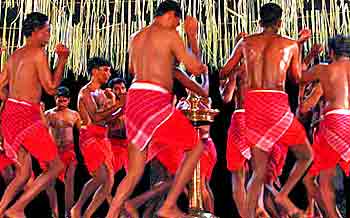 The Poorakkali dance itself is performed by a troop of young men decked in lion costumes around a huge, multi-tiered, lit lamp, also known as a “nilavilukku.” The dance involves masculine movements and acrobatic, martial art steps. No singers or musicians accompany the dance; instead, the dancers themselves keep rhythm by singing, clapping and executing synchronised foot-thumping movements. The dancers usually observe a month of abstinence and undergo strenuous practice before the performance. Most of the songs sung are hymns from The Ramayana or The Bhagavata.
The performers come from different sects of society like Maniyani, Thiyyan, Mukkuvan, Meyon, Chaliyan, Aasari, Moosari, Thattan, Kollan, etc. The basis of Poorakkali essentially is the memories of Vasanthapooja performed by inmates of different worlds like heaven, earth etc. Poorakkali spreads knowledge and entertainment. The show steals the hearts of audience with melodious songs and befitting body movements.
Payyanur, Vengara, Trikaripur and Aravath are among the places in North Malabar that are famous for this art form. The Panikkars are well-known names in the world of Poorakkali and have contributed much to the survival and expansion of this art form.
Variants of Poorakkali
Marathukali is a variant of Poorakkali. This is a form performed by two parties competently. The ordinary play lacks the competent mood displayed in Marathukali. Big disputes ensue between two parties while performance is on and learned people dissuade both parties from further confrontation.
For more information: https://en.wikipedia.org/wiki/Poorakkali