Sopana Sangeetham
Sopana Sangeetham is a form of Indian classical music that developed in the temples of Kerala in south India in the wake of the increasing popularity of Jayadeva’s Gita Govinda or Ashtapadis.
Etymology
The name derives from two Malayalam or Sanskrit words : Sopanam and Sangeetham. The word Sopanam refers to the sacred steps of main shrine of a temple and Sangeetham refers to music.
Performance
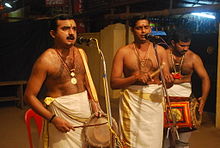
Sopana sangeetham (music), as the very name suggests, is sung by the side of the holy steps (sopanam) leading to the sanctum sanctorum of a shrine. It is sung, typically employing plain notes, to the accompaniment of the small, glasshour-shaped ethnic drum called ‘edakka’ or idakka, besides the chengila or the handy metallic gong to sound the beats. Sopanam is traditionally sung by men of the Marar and Pothuval castes of Ambalavasi (semi-Brahmin) community, engaged to do it as their hereditary profession.
Sopana sangeetham has its essential features born out of a happy blending of the Vedic, folk and tribal music of the region that’s now called Kerala. It has it set of distinct ragas like Puraneera, Indalam, Kanakurinhi, Sreekanti, Ghantaram and Samantamalahari, but has also a lot of ragas that are commonly used in the south Indian classical Carnatic music. However, unlike in Carnatic music, Sopanam follows a more uncomplicated plain-note profile (a technique called Aantolika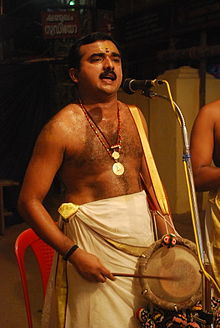 gamakam), and is canonically devoid of microtones. All the same, like in Carnatic, it has an introductory segment called alapanam (alapana), though it’s based on ‘akaaram’ or the sole use of the sound Aaa (unlike ‘ta’, ‘ra’, ‘na’, ‘ha’ or ‘ri’ that are employed in Carnatic music). This is followed by the song (paattu), quite like the concept of Kriti in Carnatic music, though, again there are no flourishes like niraval or Kalpanaswaram.
Sopana sangeetham shares at least one similarity with the north Indian classical Hindustani music in the sense that both have ragas prescribed for rendition during particular time of the day.
The structure of the Sopanam music is believed to reflect the experience of the devotee in scaling the heights of devotion. It has its beginnings through the practice of singing invocatory songs in front of the ‘Kalam’ (a stylised five-colour carpet drawing on the floor using natural powders) of Goddess Kali. That is later believed to have adopted for rendition near the temple sanctum. Like most traditional music forms, Sopanam too has its set of schools, each varying in subtleties. They include ones being sung at south Kerala temples like Pazhoor and Ramamangalam (on the banks of the river Moovattupuzha) and the northern ones like Thirumandhamkunnu and Guruvayoor (to name a few). These temples have their own set of musicians hereditarily practising the art in their precincts.
sopana sangeetha kacheri
The late Njeralattu Rama Poduval of Thirumandhamkunnu bani, Janardhanan Nedungadi of Guruvayoor and Damodara Marar, a practitioner of the temple art called Mudiyettu, from Pazhoor have been some of the most authentic experts of Sopana sangeetham. Late masters like Pallavoor Kunhukutta Marar used to present Sopana sangeetham to the accompaniment of instruments like harmonium. Experts like Thrikkambaram Krishnankutty Marar and Ooramana Rajendra Marar have strived and succeeded in presenting it in the form of a solo concert (also using the instrument called Kudukka Veena).
Sopana sangeetham is traditionally taught by the family members to the next generation. It is still the case, largely. However, these days there is a certified institute called Kshetra Kala Peetham in the temple town of Vaikom that is training students in Sopanam, besides other Kerala temple arts.
The rendition style of Sopanam, though basically a temple art, also extends to providing audio accompaniment to traditional Kerala dance-dramas like Kathakali, Krishnanattam and Ashtapadiyattam besides as devotional music in Kalam pattu and dramatic music in Mudiyettu.
For more information: https://en.wikipedia.org/wiki/Sopanam