Panchavadyam
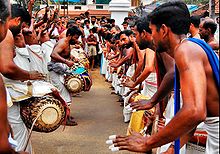
Panchavadyam( α┤¬α┤₧α╡ìα┤Üα┤╡α┤╛α┤ªα╡ìα┤»α┤é Malayalam), literally meaning an orchestra of five instruments, is basically a temple art form that has evolved in Kerala. Of the five instruments, four — timila, maddalam, ilathalam and idakka — belong to the percussion category, while the fifth one, kombu, is a wind instrument.
Much like any chenda melam, panchavadyam too is characterised by a pyramid-like rhythmic structureΓÇöwith a constantly increasing tempo coupled with a proportional decrease in the number of beats in cycles. However, in contrast to a chenda melam, panchavadyam uses different instruments (though ilathalam and kompu are common to both), is not related very closely to any temple ritual and, most importantly, permits a lot of personal improvisation while filling up the rhythmic beats on the timila, maddalam and idakka.
Panchavadyam bases itself on the 14-beat adanta (also spelt atanta) thaalam (taal), but amusingly sticks to the pattern of the eight-beat chempata thaalamΓÇöat least until its last parts. Its pendulum beats in the first stage total 1,792, and halves itself with each stage, making it 896 in the second, 448 in the third, 224 in the fourth and 112 in the fifth. After this, panchavadyam has a relatively loose second half with as many stages, the pendulum beats of which would now scale down to 56, 28, 14, 7 and three-and-a-half.
Whether panchavadyam is originally a feudal art is still a matter of debate among scholars, but its elaborate form in vogue today came into existence in the 1930s. It was primarily the brainchild of late maddalam artistes Venkichan Swami (Thiruvillwamala Venkateswara Iyer) and his disciple Madhava Warrier in association with late timila masters Annamanada Achutha Marar and Chengamanad Sekhara Kurup besides, subsequently, by the late idakka master Pattirath Sankara Marar. They together dug space for a stronger foundation (the Pathikaalam), thus making pachavadyam a five-stage (kaalam) concert with an intelligent mixture of both composed and improvised parts. Spanning about two hours, it has several phrases where each set of the instruments complement the others in a manner that is more like harmony in the Western orchestra than the concept of melody in India. Much like in Panchari and other kinds of chenda melam, panchavadyam too has its artistes lined up in two oval-shaped halves, facing each other. However, unlike any classical chenda melam, panchavadyam seemingly gains pace in the early stages itself, thereby tending to sound more casual and breezy right from its start, beginning after three lengthy, stylised blows on the conch (shankhu).
A panchavadyam is anchored and led by the timila artist at the centre of his band of instrumentalists, behind whom line up the ilathalam players. Opposite to them stand the maddalam players in a row, and behind them are the kompu players. Idakka players, usually totalling two, stand on both sides of the aisle separating the timila and maddalam line-up. A major panchavadyam will have artistes totalling around 60.
Panchavadyam is still largely a temple art, but it has come out of its precincts to be seen performed also during non-religious occasions like cultural pagentry and according welcome to VIPs.
Major Venues of Panchavadyam
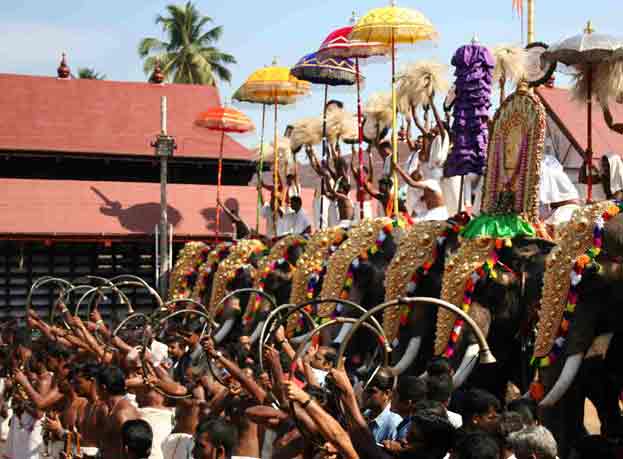
There are several central and northern Kerala temples that have been traditionally playing host to major pachavadyam performances. Prominent festivals featuring them are Thrissur Pooram (its renowned Panchavadyam event is known as ‘Madhathil Varavu’), Kaladi Panchavadyam ulsavam, Machattu Thiruvanikkavu vela, Nenmara-Vallangi vela, Vayilliamkunnu Pooram, Pariyanampatta pooram, Chinakathoor pooram, Varavoor Palakkal Karthika vela, Tirumandhamkunnu pooram purappadu, Tripunithura Sree Poornathrayeesa Aarattu, Tripunithura Thamaramkulangara Makaravilakku, Thiruvona Mahotsavam at Sree Vamanamoorthy Temple Thrikkakara and Cherpulassery Ayyappan Kavu ulsavam, besides temples in places like Chottanikkara, Odakkali, Vaikom, Ambalapuzha, Perumbavur, Pazhur, Ramamangalam, Nayathodu, Chengamanad, Elavoor,Chennamangalam, Irinjalakuda, Thiruvillwamala, Pallassena, Pallavoor and several renowned temples in Malabar like Kottakkal Viswambhara Temple and Kottakkal Pandamangalam Sreekrishna Temple and further up in Tulu Nadu.
For more information: https://en.wikipedia.org/wiki/Panchavadyam