Poothan and Thira

Poothan and Thira is a ritualistic art form found in the South Malabar region of Kerala in India, in which people dance in costumes representing Poothan, Shiva’s lieutenant, and Thira, the goddess Kali, to the accompaniment of drummers.

It is usually performed once or twice a year in villages or towns to cleanse them of evil spirits as well as in temples – especially in the Pooram festival season between December and May.
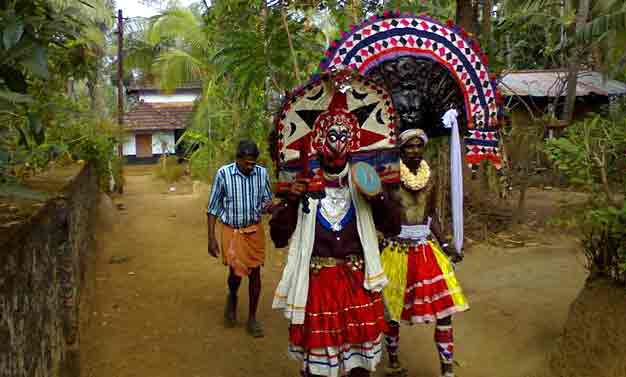
Poothan thira
A typical Poothan and Thira performance includes shouts and wild gestures and may include percussion and horns as well as drums. The dancers wear large Poothan Thira3fan-shaped head-dresses and imposing masks, often with sticking-out tongues and bulging eyes. The dancer playing Poothan usually wears a bright coloured tightly woven costume, often including bright red elements and embellished with gold-coloured trinkets that rattle when the dancer moves. The dancer playing Thira wears a semicircular black crown with symbols of the goddess embossed on it.
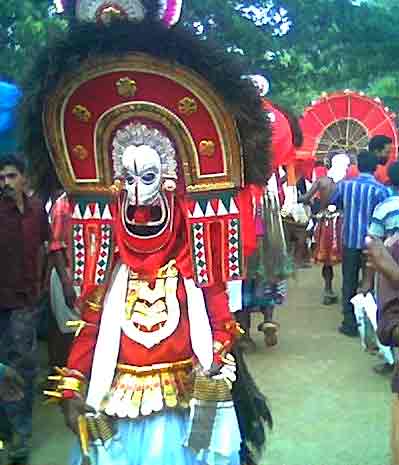
Performers are traditionally from the Mannan Hindu sub-caste of rural Palakkad, southern parts of Malappuram and northern parts of Thrissur.

The epic Malayalam poem Poothappattu by Edasseri Govindan Nair is based on the Poothan and Thira tradition.

For more information: https://en.wikipedia.org/wiki/Poothan_and_Thira

Similar Posts

  • Marathukali

    Marathukali is a variant of Poorakkali. Poorakkali is a traditional dance ritual performed by men during the nine-day Pooram festival in Bhagavathy temples across Northern Kerala (formerly known as Kolathunadu), south India. Marathukali is a form of Poorakali performed by two parties competently. The ordinary play lacks the competent mood displayed in Marathukali. Big disputes…

  • Ottamthullal

    Ottamthullal or Ottanthullal (Malayalam:α┤ôα┤ƒα╡ìα┤ƒα┤¿α╡ìΓÇì α┤ñα╡üα┤│α╡ìα┤│α┤▓α╡ìΓÇì, is a type of performing art from Kerala, India. The art form was created during the 18th century by legendary Malayalam poet Kalakkaththu Kunchan Nambiar. The story goes that Nambiar, who was playing the mizhavu for a Chakyar Koothu show, dozed off in the middle of the performance, thus inviting…

  • Yakshagana

    Yakshagana (Tulu: α▓»α▓òα│ìα▓╖α▓ùα▓╛α▓¿/Kannada: α▓»α▓òα│ìα▓╖α▓ùα▓╛α▓¿, yakß╣úagana) is a musical theater popular in the coastal and Malenadu regions of Karnataka, India. Yakshagana is the recent (200 years) scholastic name for what are known as k─ôß╕╖ike, ─üß╣¡a, bayal─üß╣¡a, bayal─üß╣¡a, da┼¢─üvat─üra (Kannada: α▓òα│çα▓│α▓┐α▓òα│å, α▓åα▓ƒ, α▓¼α▓»α▓▓α▓╛α▓ƒ, α▓ªα▓╢α▓╛α▓╡α▓ñα▓╛α▓░). It is believed to have evolved from pre-classical music and theatre during Bhakti…

  • Thacholikali

    Thacholikali is a folk art performed during the ‘Mandala Utsavam’, forty-one day annual festival at the Lokanarkavu Bhagavathy Temple. Lokanarkavu temple is situated 5 km from Vatakara, a small town in Kerala state of south India. This dance, performed during the festival resembles the martial art Kalarippayattu. Many of the traditional performing art forms of…

  • Malayikkuthu

    Malayikkuthu (Malayikuthu, Malayikkuth) is a dance ritual performed by the people of Malayi sect in Kerala, South India. Devakanni and Narada are two characters that comprise Malayikkuthu. Davakanni’s costume consists of gold and silver ornaments, pleated cloths and doted dresses. Narada wears silver ornaments and other colorful clothes. The face is decorated with turmeric and…

  • Charadupinnikkali

    Charadupinnikali or Urikkali is a dance form practiced in South Kerala. The play is performed holding the cords hung at the place of performance. At the end of play, the cords become a rough form of uri and later the uri is undone. This makes a part of Thiruvathira. For more information: https://en.wikipedia.org/wiki/Charadupinnikkali Post Views:…

Leave a Reply

Your email address will not be published. Required fields are marked *