Margam Kali
Margam Kali (Malayalam:മാര്‍ഗ്ഗംകളി) is one of the ancient group dance of Kerala practiced by Saint Thomas Christians. The dance form was practiced by the Saint Thomas Christians before the arrival of Portuguese missionaries in Kerala.
History
There are several different opinions on the origin of Margamkali. Three are:
It is traced back to Jewish wedding songs and dance from the diaspora. Scholars have found common origin among Malabar Jewish dance and songs and the Saint Thomas Christian dance form of Margam Kali.
It is derived from Sangam kali, a performance dance form of Brahmins.
It is derived from the Yathra Kali, a performance art of Nambuthiri Brahmins in Kerala.
It is derived from the early forms of Thiruvathira kali
“Margam” means path or way or solution in Malayalam, but in the religious context it is known as the path to attain salvation. The process of conversion to Christianity was known as “Margam Koodal” until recently in Kerala.Much of this folk art is woven around the mission of St. Thomas, the Apostle. The original Margam Kali describes the arrival of St. Thomas in Malabar, the miracles he performed, the friendship as well as the hostility of the people among whom he worked, the persecution he suffered, the churches and crosses he put up in various places, etc. These details are incorporated in the various stanzas of the Margam Kali songs. KeralaΓÇÖs Margam Kali is an important element in the age-old and hallowed tradition of St Thomas among the Syrian Christians of Malabar Coast.
The disparity between the present condition of this form and the early days leads one to assume three important phases in the history of Margamkali. The first phase was the pre-colonization one in which this semi-theatrical form was performed by the Saint Thomas Christians during special occasions. That time Parichamuttu Kali (The sword and shield dance) was a part of it. Later Synod of Diamper curbed and suppressed this native form. During the last seventeenth century, due to the efforts of a Knanaaya priest Itti Thomman Kathanar, the textual part of this form got certain upliftment and care. The Margamkali might have been edited and refashioned into the present fourteen stanza structure during this time. However, till the fag end of the nineteenth century the art form was not very much in practice even though it did exist here and there. But at the end of the nineteenth and the beginning of twenteenth century, the form became popular once again and some structural changes took place then. Masters such as Kalarikal Unni aasaan, Indumoottil Kocheppu aasaan, Indumoottil Kutto aasaan were some of them who were responsible for this change and upheaval. By this time puttan Purikkal Uthuppu Lukose compiled and published Margamkali Pattukal in 1910. In this second phase the Knanaaya Christian community acquired this form as their own tradition and heritage.[8]Then again it had a set-back and during the 1950ΓÇÖs to 1970ΓÇÖs it was on the verge of becoming extinct. But in the late 1970ΓÇÖs once again the Syrian Christians took the initiative to revive and popularise this form.
Performance
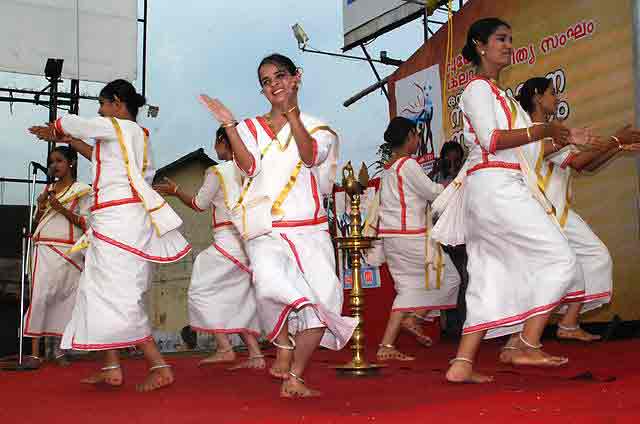
A dozen dancers sing and dance clapping around a Nilavilakku wearing the traditional white dhoti (“mundu”) and blouse (“chatta”). The lamp represents Christ and the performers his disciples. The performance is usually held in two parts (“padham”) and begins with songs and dances narrating the life of St.Thomas, the apostle. It then takes a striking turn with a martial play of artificial swords and shields. Margamkali does not use any instruments other than two small palm size cymbals played by the same person who sings the song. In the early days only men performed Margam Kali. Today women also perform the custom.
Today
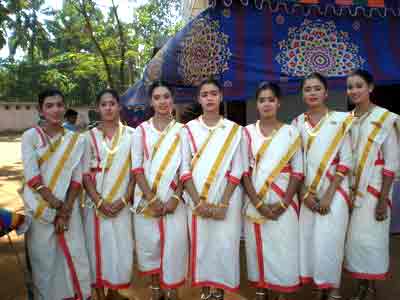
Currently both Margam Kali and Parichamuttukali are included in the State Youth Festival of Kerala. This makes these art forms a competitive item in the Four-tier system (i.e. School, Sub District, Revenue and State level) Youth festival. The Margam Kali is performed mainly by the women in cultural shows and by school children in competitions.
For more information: https://en.wikipedia.org/wiki/Margam_Kali