Kummattikali

Kummattikali or Kummatti Kali is the famous colorful mask-dance of Kerala, South Malabar in particular. During the festival of Onam, Kummattikali performers move from house to house collecting small gifts and entertaining people. Kummatti dances are rampant in the Thrissur district during Onam. Pristine or original form of Kummattikali can be seen in the Bhadrakali temple in Palghat district.

Costumes

The costumes are a most interesting facet of Kummattikali. The dancers don a heavily painted colourful wooden mask depicting faces of Krishna, Narada, Kiratha, Darika, or hunters. These masks are usually made out of saprophyte, jack fruit tree, Alstonia scholaris, Hog Plum tree or the Coral tree.

The dancers wear skirts woven out of plaited grass. Some cover their whole body with bunches of grass for a more bushy appearance. The semblance is made more joyful with the ‘talla’ attached externally to the mask giving the appearance of a toothless open mouth. Dancers also hold and manipulate long sticks of residuary agricultural produce called ‘Kummattikali’: it is from this that the dance derives its name. Their dance is related to Shaiva myth. ‘Thamma’ (an old woman) walks in front with the help of a stick. Thamma is symbolic of mother of every being and everything.

Kummatti dancers are a sight to watch as they move around from house to house collecting jaggery, rice, or small amounts of cash. Onlookers, specially children take great delight in their performance.

Performance
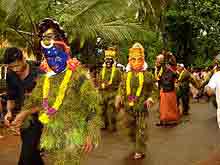
Kummattikkali
The rhythm for the dance movements is provided by vibrating the string of a bow like instrument called an Onavillu. Areca nut wood is used to make the bow and the strings are beaten with a narrow bamboo stick.

The themes of Kummattikali are mostly taken from the stories of Ramayana, Darika Vadham, the story of Shiva and folk tales like Manjan Nayare Pattu.
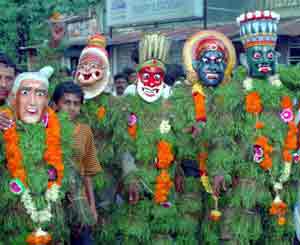
Kummattikkali
It may be noted that folk art of Kerala can be classified into two broad categories – ritualistic and non-ritualistic. Ritualistic can be further divided into – Devotional, performed to please a particular god and goddess and Magical Art Forms. Theyyam, Thira, Poothamthira, Kannyar Kali, Kummattikali, etc. are some of devotional art forms.

For more information: https://en.wikipedia.org/wiki/Kummattikali

Similar Posts

  • Chavittu Nadakam

    Chavittu Nadakam (Malayalam:α┤Üα┤╡α┤┐α┤ƒα╡ìα┤ƒα╡üα┤¿α┤╛α┤ƒα┤òα┤é) is a highly colorful Latin Christian classical art form originated in Gothuruth village, Kerala state in India. It is noted for its attractive make-up of characters, their elaborate costumes, detailed gestures and well-defined body movements presented in tune with the rhythmic playback music and complementary percussion. This art form highly resembles European…

  • Poorakkali

    Poorakkali (Malayalam: α┤¬α╡éα┤░α┤éα┤òα┤│α┤┐) is a traditional dance ritual performed by men during the nine-day Pooram festival in Bhagavathy temples across North Malabar in Kerala State of south India. The Pooram festival begins with the Karthika asterism and concludes with the Pooram asterism of the month of Meenam according to the Malayalam calendar (corresponding to the…

  • Mudiyettu

    Mudiyett or Mudiyettu is a traditional ritual theatre and folk dance drama from Kerala that enacts the mythological tale of a battle between the goddess Kali and the demon Darika. The ritual is a part of the bhagavathi or bhadrakali cult. The dance is performed by a set of people known as Kuruppanmar and is…

  • Panchavadyam

    Panchavadyam( α┤¬α┤₧α╡ìα┤Üα┤╡α┤╛α┤ªα╡ìα┤»α┤é Malayalam), literally meaning an orchestra of five instruments, is basically a temple art form that has evolved in Kerala. Of the five instruments, four — timila, maddalam, ilathalam and idakka — belong to the percussion category, while the fifth one, kombu, is a wind instrument. Much like any chenda melam, panchavadyam too is…

  • Charadupinnikkali

    Charadupinnikali or Urikkali is a dance form practiced in South Kerala. The play is performed holding the cords hung at the place of performance. At the end of play, the cords become a rough form of uri and later the uri is undone. This makes a part of Thiruvathira. For more information: https://en.wikipedia.org/wiki/Charadupinnikkali Post Views:…

  • Ottamthullal

    Ottamthullal or Ottanthullal (Malayalam:α┤ôα┤ƒα╡ìα┤ƒα┤¿α╡ìΓÇì α┤ñα╡üα┤│α╡ìα┤│α┤▓α╡ìΓÇì, is a type of performing art from Kerala, India. The art form was created during the 18th century by legendary Malayalam poet Kalakkaththu Kunchan Nambiar. The story goes that Nambiar, who was playing the mizhavu for a Chakyar Koothu show, dozed off in the middle of the performance, thus inviting…

Leave a Reply

Your email address will not be published. Required fields are marked *