Kuthiyottam
Kuthiyottam is one of the main offering at the Chettikulangara Devi Temple.It is a ritualistic symbolic representation of human bali (Human Sacrifice).
Kali is one of the most significant divinities, and many texts and contexts treat Kali as an independent deity, not directly associated with a male god. In case she is associated with a male god, it is invariably Shiva. In this aspect, she represents the omnipotent Shakti of Shiva. She holds both the creative and destructive power of time.
The earliest reference to Kali in Hindu tradition date back to the 6th century, and locate her in the battle fields fighting asuras. Her temples are recommended to be built away from human habitations. Vana Bhatta’s 7th century drama Kadambari features a goddess named Chandi, an epithet of both Kali and Durga.
KaliΓÇÖs most famous appearance in battle contexts are found in the Devi Mahatmya when during the battle with asuras, Durga becomes angry. Her face turns pitch dark, and suddenly Kali springs forth from DurgaΓÇÖs forehead. She is black, wears a garland of human heads, is clothed in a tiger skin, and wields a staff topped by a human skull. She destroys the asuras. Later, Durga seeks her assistance once more to annihilate Raktabija. KaliΓÇÖs mythology recounts several such appearances, mostly in terrible aspects.
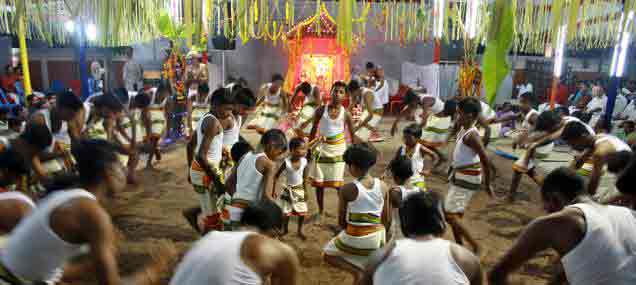
Young two boys between 8 to 14 years are taught Kuthiyottam, a ritual dance in the house amidst a big social gathering before the portrait of the deity. Early in the morning on Bharani, after the feast and other rituals, the boys whose body is pierced with a silver wire, one end of which is tied around their belly and an arecanut fixed on the tip of a knife held high over their head are taken in procession to the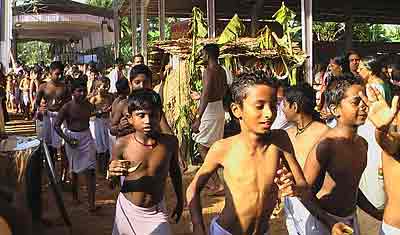 temple with the accompaniment of beating of drums, music, ornamental umbrellas, and other classical folk art forms, and richly caparisoned elephants.All through the way to the temple tender coconut water will be continually poured on their body. After the circumambulation the boys stands at a position facing the Sreekovil (Sanctum Sanctorum) and begins to dance. This ceremony ends with dragging the wire pierced to the skin whereby a few drops of blood comes out. Kuthiyotta KalarisΓÇÖ, run by Kuthiyotta Asans (Teachers or leaders), train the group to perform the dances and songs. Normally, the training starts about one to two months before the season.Boys of this locality received well training in performing Kuthiyotta chuvadu (dance)and paattu (song) from their childhood itself.
Folklore exponents see this art form, with enchanting well structured choreography and songs, as one among the rare Adi Dravida folklore traditions still preserved and practiced in Central Kerala in accordance to the true tradition and environment. Typical to the Adi Dravida folk dances and songs, the movements and formations of dancers (clad in white thorthu and banyan) choreographed in Kuthiyottam are quick, peaks at a particular point and ends abruptly. The traditional songs also start in a stylish slow pace, then gain momentum and ends abruptly.
On this day just after midday the residents of the locality bring huge decorated effigies of Bhima panchali, Hanuman and extremely beautiful tall chariots in wheeled platforms, and after having darshan the parties take up their respective position in the paddy fields lying east of the temple.
During the night, the image of Devi will be carried in procession to the effigies stationed in the paddy fields. On the next day these structures will be taken back. A big bazaar is also held at Chetikulangara as part of this festival. Kuthiyottam is the main vazipadu of the Chettikulangara temple, Mavelikkara.
For more information: https://en.wikipedia.org/wiki/Kuthiyottam