Mudiyettu
Mudiyett or Mudiyettu is a traditional ritual theatre and folk dance drama from Kerala that enacts the mythological tale of a battle between the goddess Kali and the demon Darika. The ritual is a part of the bhagavathi or bhadrakali cult. The dance is performed by a set of people known as Kuruppanmar and is performed in temples called ‘Bhagvati Kavus’, the temples of the Mother Goddess, between February and May after the harvesting season. In 2010 Mudiyettu was inscribed in the UNESCOΓÇÖs Representative List of the Intangible Cultural Heritage of Humanity, becoming the second art form from Kerala after Koodiyattam
The Kali – Darika Myth
Darika was a demon who received a boon from Brahma which granted that he would never be defeated by any man living in any of the fourteen worlds of Hindu mythology. This made Darika immensely powerful and arrogant. Armed with this boon, Darika went on to conquer the world defeating even Indra, the king of the gods. As his atrocities became intolerable, the sage Narada requested Shiva to contain Darika. Shiva agreed, circumventing Brahma’s boon by declaring that Darika would be killed by the goddess Kali, she being a woman and one not born among the humans.
Features of Mudiyett
Mudiyett is a village ritual performed by members of the Marar and Kuruppu communities in Thrissur, Ernakulam, Kottayam and Idukki districts of Kerala. However, the entire community contributes to and participates in it. Mudiyettu is performed annually in ΓÇÿBhagavati KavusΓÇÖ, the temples of the goddess, in different villages along the rivers Chalakkudy Puzha, Periyar and Moovattupuzha.
The ritual begins with the drawing of a large, impressive and ferocious image of goddess Bhadrakali on the floor of the temple. The Goddess holds in her hands multiple weapons and the depiction of her hands, which range from eight to thirty two, determines the size of the drawing. These hands are drawn in perfect symmetry in accordance with tantric calculations. The image acquires a three-dimensional effect as two mounds of coloured powder are placed on the goddessΓÇÖ breasts. This image is called a kalam and is drawn entirely using organically derived coloured powder and it imbues the performers with the spirit of Kali. This process of painting the kalam, which is the image of bhadrakali, is called kalam ezhuthu. An elaborate ritual prayer, called kalam puja is offered to this image of Bhadrakali and it is accompanied by the singing of hymns called kalam pattu.
The spirit of the deity, bhadrakali, is believed to reside in a sacred tree on the temple 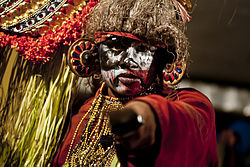 premises and at the foot of this tree a lamp is lit. This lamp is brought into the temple in a procession comprising musicians and devotees where it is placed on the kalam. This lamp is then brought to the proscenium from the kalam and with this, the second part of the ritual, the enactment of the Kali- Darika myth begins. The beating of drums invites the devotees to witness the performance. Two people holding a curtain appear on the scene while a chorus sings songs of invocation. This is the Poorva Ranga or the prologue of the play and is followed by the enactment of the Kali-Darika myth in the temple courtyard. Kali eventually vanquishes the demon and his headgear or Mudi is removed, signifying decapitation. The musical accompaniment to the play is primarily through the chenda and the elathalam, besides vocal accompaniment in the Sopana Sangeetham style. The lyrics are in a mix of Malayalam and Tamil.
The major characters in the Mudiyettu performance are Lord Shiva and Narada, Kali,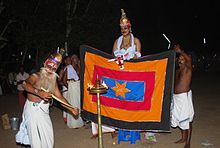 Koimbata Nair, a character bearing resemblance to the Sanskrit drama’s Sutradhar and Kooli, who provides comic relief. The performance comes to an end with the decapitation of Darika and Kali then showers her blessings on the populace, especially infants. The ritual ends with the distribution of prasadam, or sacramental offerings, by the performers to the assembly in the form of flowers and other materials used in the ritual. The Mudiyettu performance symbolically heralds the dawn of peaceful and prosperous new year by purifying and rejuvenating the entire community.
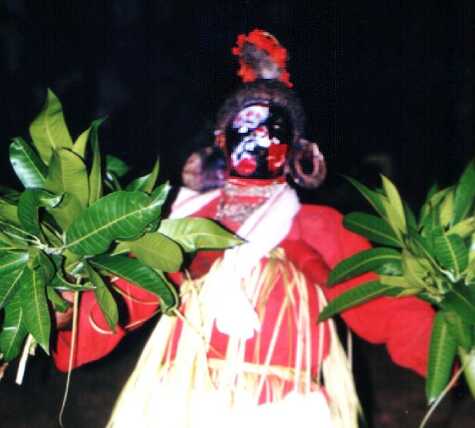
There’s no rehearsal or preparation involved in playing Kali. The performance is a 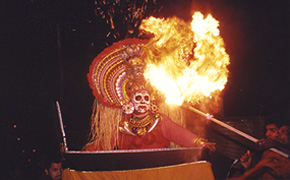 natural progression from Lord Shiva, Narada, demons Danavan and Darikan to Kali. A complete Mudiyettu performance requires a total of 16 personsΓÇö including percussionists, Kalamezhuthu artists, vocalists. There are also evident regional differences in the attire and performance styles of Mudiyettu. Thus, in the Koratty style, Kali exhibits a bare torso, covered only by a breast-shaped plank while in in the Keezhillam and the Pazhoor styles, she wears a full upper body dress. Similarly, in the Koratty style, Darika’s mudi resembles the Kathakali crown and his face paint the Kathi Veshas of Kathakali. This points to how the two forms have become interlinked even though Mudiyettu predates Kathakali, with epigraphists tracing its evolution as an art to even the 9th or 10th century AD
For more information: https://en.wikipedia.org/wiki/Mudiyett