Kerala Natanam
Kerala Natanam can be called a stylised form of Kathakali. Guru Gopinath developed his own style that was appealing to the masses who were then devoid of art and dance, without compromising on the classical background. He never tried to reform Kathakali and to tamper with the originality and purity it possessed.He was instrumental to bring Kathakali out from the courtyards of upper class Brahmins and rajas and dance chambers of temples to the masses. His performances created a dance wave in Kerala, which had reprecations all over India in thirties and forties
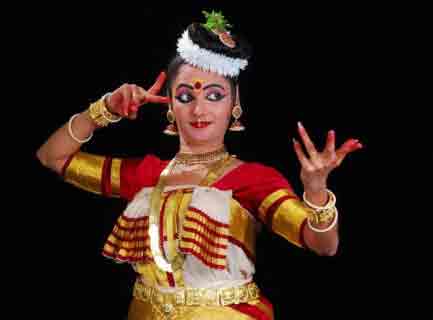
Guru Gopinath and Thankamani’s dance programs found traditional pieces existing side by side with those modified to present a variety of themes. Their style relied heavily on the angika abhinaya – body movements and gestures – and satvika abhinaya – facial expressions from Kathakali. The major stance of Kathakali was however changed by Gopinath to a more convenient pose that could still rest well with the tribhanga concept.
Another significant deviation was in aharya abhinaya- costume mode) where they adopted costumes and facial makeup to suit the role. Thus in a dance on Jesus Christ the dancer dressed like Christ. In social dances the artists wore the dress of labourers, peasants, folk etc. Likewise roles of Srikrishna, king, snake charmer, hunter had the appropriate attire. For the first time Carnatic music compositions used for concerts were rendered into dance forms by Gopinath. Unlike traditional Kathakali and Mohini attam, a variety of many musical instruments were also added to his presentations.
Even though during his lifetime Guru Gopinath did not give a name to his style after his death the movement to give his style a name gained momentum. In 1993, during the Global Conference on Guru Gopinath and Kerala Natanam held in Trivandrum, a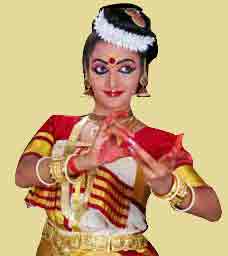 Sanskrit definition was given to this style by his students. KERALEEYA SHAASTRIYA SARGAATHMAKA NRITTHAM- “A traditional creative dance style originating from Kerala.”
Kerala Natanam can be performed in three ways : Ekamga Natanam i.e. solo, Samgha Natanam i.e. group, Nataka Natanam i.e. dance drama enacting a story. Male female pair dancing( duet) is also a distinct style in Kerala natanam. So also he has extended the dance drama to 5 or six hours long dance performance called Indian ballets.
For more information: https://en.wikipedia.org/wiki/Kerala_Natanam