Kerala mural painting

Kerala mural paintings are the frescos depicting mythology and legends, which are drawn on the walls of temples and churches in South India, principally in Kerala. Ancient temples, churches and palaces in Kerala, South India, display an abounding tradition of mural paintings mostly dating back between the 9th to 12th centuries CE when this form of art enjoyed Royal patronage.
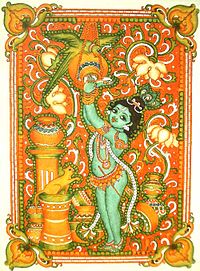
Kerala Mural Paint
Fresco-Secco

The masterpieces of Kerala mural art include: the Shiva Temple in Ettumanoor, the Ramayana murals of Mattancherry Palace and Vadakkumnatha kshetram. The “Gajendra Moksham” mural painting in the Krishnapuram Palace near Kayamkulam and the mural paintings in the sanctom of Padmanabha temple at Thiruvananthapuram are very famous.

St. George Syrian Orthodox Church of the nasranis, depicting Biblical narrations. The fresco paintings of Kerala is called as “Fresco-secco”. Its features are the lime medium and technique in which the prepared walls are painted only after it gets completely dry. It is derived probably from the ancient art of Kalamezhuthu. It adheres to the principles of the ‘Shilparatna’, the principal text on Indian painting techniques. It specifies that white, yellow, red, black and terreverte or Syama are the pure colours to be used as pure colours or in combination to make murals.
Murals

The murals of Thirunadhikkara Cave Temple (now ceded to Tamil Nadu) and Tiruvanchikulam are considered the oldest relics of KeralaΓÇÖs own style of murals. Fine mural paintings are depicted in temples at Trikodithanam, Ettumanur, Vaikom, Pundarikapuram, Udayanapuram, Triprangode, Guruvayoor, Kumaranalloor, Aymanam, the Vadakkunathan temple in Trichur, the Thodeekalam temple in Kannur and the Sri Padmanabhaswamy temple at Thiruvananthapuram. Other mural sites are in the churches at Edappally, Vechur, Cheppad and Mulanthuruthy, and at palaces such as the Krishnapuram Palace near Kayamkulam and the Padmanabhapuram Palace.
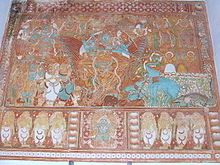
Mural Painting
The traditional style mural art form, using natural pigments and vegetable colours, is being revived by a new genre of artists actively involved in researching and teaching mural art at the Sree Sankara Sanskrit College in Kalady and also at a mural art school associated with the Guruvayoor temple.


For more information: https://en.wikipedia.org/wiki/Murals_of_Kerala

Similar Posts

  • Sarpam Thullal

    Many ancient family houses in Kerala have special snake shrines called Kavu. Sarpam Thullal is usually performed in the courtyard of houses having snake shrines. This is a votive offering for family wealth and happiness. The dance is performed by members of a community called Pulluvar. In the first stage the pulluvan draws a kalam…

  • Duffmuttu

      Duffmuttu (also: Dubhmuttu)(Malayalam:α┤ªα┤½α╡ü α┤«α╡üα┤ƒα╡ìα┤ƒα╡ì) is an art form prevalent among Muslims in Kerala state of south India using the traditional duff, or daf, also called Thappitta. Participants dance to the rhythm as they beat the duff. The tradition method of playing this is by standing in a u shape, then singing byth i.e. the…

  • Mudiyettu

    Mudiyett or Mudiyettu is a traditional ritual theatre and folk dance drama from Kerala that enacts the mythological tale of a battle between the goddess Kali and the demon Darika. The ritual is a part of the bhagavathi or bhadrakali cult. The dance is performed by a set of people known as Kuruppanmar and is…

  • Nangiar Koothu

    Nangi╟Är K┼½thu or Nangyar Koothu is an allied traditional art of Kutiyattam, an age-old Sanskrit drama tradition of India. It is performed traditionally by the women of the Ambalavasi Nambiar community of Kerala, known as Nangyaramma, but has transcended the caste barrier since the second half of the 20th century. Nangiarkoothu, an offshoot of Kutiyattam,…

  • Kolkali

    Kolkali (Malayalam:α┤òα╡ïα┤▓α╡ìΓÇìα┤òα┤│α┤┐) is a folk art performed in North Malabar region of Kerala State in south India. The dance performers move in a circle, striking small sticks and keeping rhythm with special steps. The circle expands and contracts as the dance progress. The accompanying music gradually rises in pitch and the dance reaches its climax….

  • Charadupinnikkali

    Charadupinnikali or Urikkali is a dance form practiced in South Kerala. The play is performed holding the cords hung at the place of performance. At the end of play, the cords become a rough form of uri and later the uri is undone. This makes a part of Thiruvathira. For more information: https://en.wikipedia.org/wiki/Charadupinnikkali Post Views:…

Leave a Reply

Your email address will not be published. Required fields are marked *