Kolam Thullal
Kolam Thullal is a ritual dance form prevalent in south Kerala, southern India. It is customary in houses and temples of Bhagavathy, a female deity. It is performed at temple festivals and to drive away evil spirits from the “possessed” bodies. Its origins lie with the Tinta group of the Kaniyar caste.Tippu Sultan.
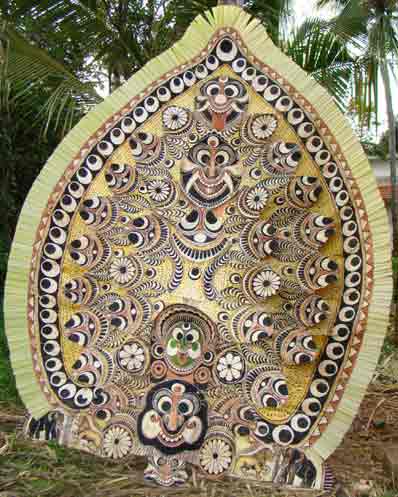
Kolam thullal is performed in the light of burning Choot [ Dry coconut leaf lets made in to a bundle] . Both Kavilamma and the villagers may be possessed by some wicked deities.Holding the kolam as face mask, artist performs dances with specific leg movements and foot steps. Towards the end, it is supposed the deity shows its presence and becomes one with the performer.The atmosphere becomes tense, colourful and noisy with arppuvili, Kathina vedi 7 Vai kurava .The deity takes quick and rhythmic strides.In a few minutes everything attain a pacificd mood. Now it is decided Kavilamma and villagers are safe guarded from the ill effects of wicked deities.
Faces are named as Kimpiri, Krishnamudi & Cherumukham.Around these faces there will be incomplete drawing of Sarppa mukham such as Chuzhippu and flowers.Edge of the kolam is ovalshaped Puravada made by a stitching together a number areca leaf sheaths .Edge is yellow with rice shaped black dots on it. Outer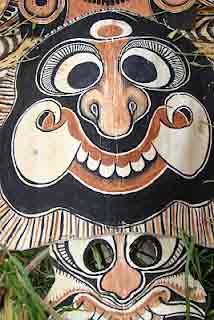 to this there will be eyes or sarpakkettu .Elephant and Lion painted on the ears of Bhairavi where as flowers for Kalayekshi & Kanjiramala. Kalayekshi kolam triangular pieces of areca leaf sheath are fixed on the edges and shoolam with eye is painted on each piece.All the kolams have chest shield.On the shield entangled serpent looking face to face are painted on the breast.
The kolam made of one thousand and one are leaf sheath is stitch frotened to the wooden frame and is moved on wheels.
Large Kolam
Kolams of Bhairavi, Nina bhairavi,Kanjiramala, Kalayaekshi etc are made using fifty one , hundred and one or thousand and one areca leaf sheaths . These huge kolams are stitch to frames or vertically split areca palm sheaths .Unplaned areca laeves warmed in sunlight is stitched to make pointed caps. Two holes are made either sides of the cap.A strong piece of vertically split areca palm is inserted through the holes and another one inserted vertically through the pointed top of the cap.Lower end of this, rests on the already fixed horizontal piece.A 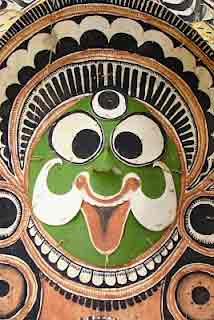 number of pieces fixed on this structure both vertically and horizontally .Kolam is stitch fixed on this frame work.Number of faces drawn on such kolams vary as 3, 5, 7, 9 or 12.
Eye portion is removed leaving behind circular holes.From behind unplaned leaf sheath fixed stiching across it with borny vein of tender coconut leaf.This is toavoid the chance of thin plained sheaths being rolled and rouined by itself.The process is called ‘ Padiveckal’ .
Kolamezhuthu commences after the kolam strong and well aligned.Eyes are drwn first while painting faces.For each line, there will be a ‘Thuna vara ‘ just out of it. Eyes , protuded teeth etc are drawn in accordance with the deity concept.
For more information: https://en.wikipedia.org/wiki/Kolam_Thullal