Indian National Animal Tiger
National Animal of India
Indian National Animal – Tiger
Tiger is scientifically known as Panthera tigris. It is a member of the Felidae family and the largest of the four ΓÇÿbig catsΓÇÖ of the Panthera genus. On an average, a tiger is about 13 feet in length and 150 kilograms in weight. The pattern of dark vertical stripes that overlay near-white to reddish-orange fur is the distinct recognition of a tiger. By nature, the tiger is a keen predator and carnivore. The Panthera tigris is a native of the eastern and 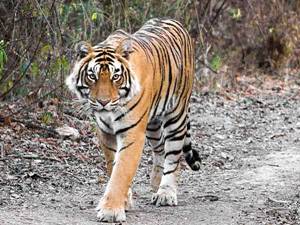 southern Asia . Known as Lord of Jungles due to its grace, agility, power and endurance, Tiger is also the national animal of India .
Choice of Tiger as National Animal
Tiger was chosen as the National animal of India due to its grace, strength, agility and enormous power. As the tiger is also considered as the king of Jungle, it was an obvious choice for the National Animal category. Since time immemorial, the tiger has been considered as a Royal Animal. Often, The Tiger as the National Animal of India symbolizes the power, strength, elegance, alertness, intelligence and endurance of the nation.
Declining Population of Tiger
There is a steep fall in the population of tigers in the world. Due to illegal smuggling of Tiger Skin and other body parts, there are very few tigers left in the world today. According to the World Census of Tigers, there are only 5000 -7000 tigers in the world today. Out of which, Bangladesh, Nepal, Bhutan, China and Myanmar claim to have a population of 3000 to 4500 and India alone claims to have a population of 2500 to 3750. In India , out of the eight known races of the Panthera Tigris species, the Royal Bengal Tiger, is found throughout the country except in the north-western region.
Project Tiger in India
Due to the extreme threat of extinction of the tiger species from the country, the Indian Government launched Project Tiger in 1973. Project tiger was focused to preserve the remaining tiger population in the country and increase the breeding of the species so that new population could be added to the existing one. Under this Project, 23 tiger reserves were established throughout the country, covering an area of 33,406 sq. km for providing safe and comfortable shelter to the tigers in the natural environment. By 1993, there was much improvement in the tiger population in the country. However despite the increase in population, the population of tigers in the country is still not satisfactory compared to the effort and money put in the project. This is due to the illegal poaching of the tigers and negligence of authorities towards the alarming situation of the tiger population in the country.