National Fruit of India
Mango, cultivated in India since times immemorial, is regarded as the National Fruit of the country. Described as the “Food of the Gods”, in the sacred Vedas, the fruit is grown almost in all parts of India , except the hilly areas, but is mainly available in the summer season only.. There are more than 100 varieties of mangos in India , in a range of colors, sizes, and shapes. The common names used in context of the fruit are, Mangot, Manga, and Mangou. The eact origin of the term ‘mango’ is not known. It is believed to have come from the Portuguese term ‘manga’, which is probably from Malayalam ‘manga’.
Mango finds a mentioned in the Indian history as well. In fact, the famous poet Kalidasa is known to have sung its praises. Apart from that, ancient Greek King Alexander the Great and Chinese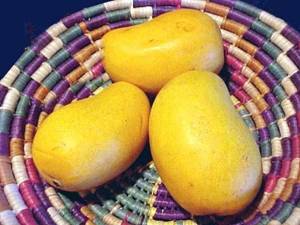 pilgrim Hieun Tsang have been said to have savored its taste. Historical records also mention the instance of Mughal Kinf Akbar planting 100,000 mango trees in Darbhanga, known as Lakhibagh. Mangos, liked for their sweet juice and bright colors all around the world, are known to be rich in vitamin A, C, and D.
Description
Mangoes are available in different sizes, ranging from 10 to 25 cm in length and 7 to 12 cm in width. In terms of weight, a single mango can be as heavy as 2.5 kg. The fruit come in a wide variety of colors, such as green, yellow, red, and even various combinations of all these colors. Mango has a flat, oblong seed in the center, which is covered by the sweet pulp. Covering the pulp is a thin layer of skin, which is peeled off before eating the fruit. When ripe, the unpeeled fruit gives off a distinct, resinous sweet smell.
Varieties
A large number of mango varieties can be found in India . the most popular ones include ‘Alphonso’ (also called ‘Hapoos’), ‘Amrapali’, ‘Bangalora’, ‘Banganapalli’ (also known as ‘Benishaan’) , ‘Bombay’, ‘Bombay Green’, ‘Chausa’, ‘Chinna Rasalu’, ‘Dashaheri’ (‘Daseri’), ‘Fazli’, ‘Fernandian’ , ‘Gulabkhas’, ‘Himayath’ (a.k.a. ‘Imam Pasand’), ‘Himsagar’, ‘Jehangir’, ‘Kesar’, ‘Kishen Bhog’, ‘Lalbaug’, ‘Langda’ (‘Langra’), ‘Mallika’, ‘Mankurad’, ‘Mulgoa’, ‘Neelam’, ‘Pairi’, ‘Pedda Rasalu’, ‘Rajapuri’, ‘Safeda’, ‘Suvarnarekha’ , ‘Totapuri’, ‘Vanraj’ and ‘Zardalu’.
Cultivation
Frost-free climate is best for the growth of Mangos. If temperatures drop below 40? F, even for a short period, the flowers and small fruits already grown on the tree can get killed. In other words, warm and dry weather is required for the cultivation of the fruit. This is it available in the summer season only. Mango can grow well in large containers and a greenhouse as well. Mango trees are shady in nature.. They grow very fast and can reach a height of as much as 65 ft. The life of mango trees is generally very long and some specimens are known to be over 300 years old and still fruiting.