National Bird of India
Indian National Bird – Peacock
The Peacock, Pavo cristatus (Linnaeus), is the national bird of India . Emblematic of qualities such as beauty, grace, pride and mysticism, it is a multihued, swan-sized bird, with a fan-shaped crest of feathers, a white patch under the eye and a long, slender neck. Much in contrast to the natural phenomenon, the male specie of the bird is much more strikingly stunning than its female counterpart. The male bird, peacock, flaunts a gleaming blue breast and neck and a spectacular bronze-green train of around 200 elongated feathers. It is capable of extending its tail erect like fan as ostentatious display.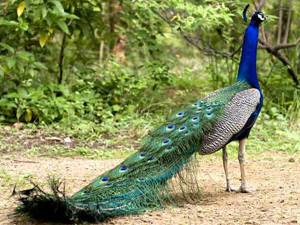
The elaborate courtship dance of the male, fanning out the tail and preening its feathers is a beautiful sight. On the other hand, the female bird, peahen, slightly smaller than its male counterpart. Brownish in color, the female bird also lacks the train visible in the male specie. Peacock is predominantly found in the Indian sub-continent, ranging from the south to east of the Indus river. Jammu and Kashmir , east Assam , south Mizoram and the whole of the Indian peninsula also is home to this impeccable bird. The bird lives in jungle lands near water and is thus, chiefly found in the wilds in India (sometimes, domesticated in villages as well).
Peacock is illustrated in pictures accompanying Indian Gods and Goddesses. The sacred bird of the India , the bird was once bred for food, but now hunting of peacocks is banned in India . It is protected not only by a religious sentiment, but also by parliamentary statute. Peacocks have been given full protection under the Indian Wildlife (Protection) Act, 1972. Apart from India , it is also involved to the cultures prevalent in Far East , Ancient Persia, Greek and Christian. While the figure of peacock features in various Islamic religious buildings, the bird is symbolic to ‘Resurrection of Christ’ in Christianity.
Coming back to Hinduism, peacock is portrayed as the image of the God of thunder, rains and war, Indra. People believe that, when a peacock extends its tail erect like fan for an enchanting and mesmerizing demonstration, it indicates that rainfall is on the cards. Though this might sound strange, but the fact is somewhat true. On seeing the dark clouds, peacock outspreads its tail and starts dancing in rhythmic fashion. Its dance movement has been incorporated in most of the Indian folklore, including Bharatha Natyam. In southern part of India , peacock is considered as a ‘vahana’ or vehilce of lord Muruga.
Features Of Peacock
The male specie, peacock, is characterized with a 2.12 m (7.3 ft) length, in full breeding plumage, and weighs about 5 kg (11 lbs). The female bird – peahen, on the other hand, is about 86 cm (34 in) long and weighs about 3.4 kg (7.4 lbs). Adoring the glistening blue-green plumage, the Indian peacock has an extension of feathers on its back. Each feather is exemplified with an eye at its end. The Indian peahen is a mixture of dull green, grey and iridescent blue, with the greenish-grey color outweighing. The bird is mostly found in the dry semi-desert grasslands, scrub and deciduous forests and feeds on mainly seeds, but some also eat insects, fruits and reptiles.