National Tree of India

Indian fig tree, Ficus bengalensis, whose branches root themselves like new trees over a large area. The roots then give rise to more trunks and branches. Because of this characteristic and its longevity, this tree is considered immortal and is an integral part of the myths and legends of India. Even today, the banyan tree is the focal point of village life and the village council meets under the shade of this tree.

National Tree of India – Banyan – Ficus bengalensis or the Banyan tree is the National Tree of India. Belonging to the fig family, the branches of the Banyan spread over a large area take roots and keep on living and regenerating for thousands of years. Over the years, it consistently gains more trunks and branches that add to its longevity. According to the Indian mythology, it is considered immortal. Many of the Indian villages are centered around large shady banyan trees that provide a good place for public meetings and meetings of the village council. The tree has the widest reaching roots of all the trees and can easily extend to several of acres.
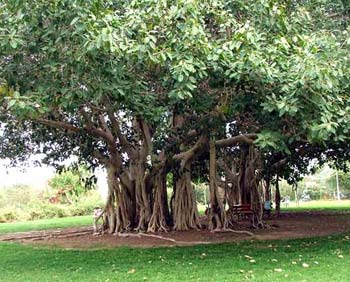
The size of the banyan tree, its alleged immortality and its religious significance in India made in an obvious choice to be chosen as the National Tree of India. It served to provide leafy shelter to a number of weary Indians who would use it to give themselves some rest in its shade from the blazing hot summer sun. Indians have long honored this tree and many folklores and mythological legends are attached to it. Some of the Hindu rituals make it even more prominent. Besides the humans, it provides shelter to many other creatures. It is also known to need little maintenance and is virtually a boon to Indians.

Similar Posts

  • Prime Ministers of India

    Jawaharlal Nehru Aug. 15, 1947 – May 27, 1964 Gulzari Lal Nanda May 27, 1964 – June 9, 1964 (Interim) January 11 –  24, 1966(Interim) Lal Bahadur Shastri  June 9, 1964 – January 11, 1966 Indira Gandhi Jan. 24, 1966 to March 24, 1977 Morarji Desai March 24, 1977 to July 28, 1979 Charan Singh…

  • National Flower of India

    Lotus, botanically known as the Nelumbo Nucifera is the national flower of India . The Lotus plant is basically an aquatic plant with wide floating leaves and bright aromatic flowers which grow only in shallow waters. The Lotus plant has floating leaves and flowers. It has long aerated stems.. The lotus flowers are extremely beautiful…

  • Currency Symbol

    The symbol of Indian Rupee typifies India’s international identity for money transactions and economic strength. The Indian Rupee sign is an allegory of Indian ethos. The symbol is an amalgam of Devanagari “Ra” and the Roman Capital “R” with two parallel horizontal stripes running at the top representing the national flag and also the “equal…

  • State Emblem

    The state emblem is an adaptation from the Sarnath Lion Capital of Ashoka. In the original, there are four lions, standing back to back, mounted on an abacus with a frieze carrying sculptures in high relief of an elephant, a galloping horse, a bull and a lion separated by intervening wheels over a bell-shaped lotus….

  • National Fruit of India

    Mango, cultivated in India since times immemorial, is regarded as the National Fruit of the country. Described as the “Food of the Gods”, in the sacred Vedas, the fruit is grown almost in all parts of India , except the hilly areas, but is mainly available in the summer season only.. There are more than…

Leave a Reply

Your email address will not be published. Required fields are marked *