Kerala Mythological origins
There are myths concerning the origin of Kerala. One such myth is the creation of Kerala by Parasurama, a warrior sage. The Brahminical myth proclaims that Parasurama, an Avatar of Mahavishnu, threw his battle axe into the sea. As a result, 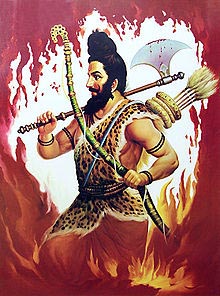 the land of Kerala arose and was reclaimed from the waters.
He was the sixth of the ten avatars (incarnation) of Vishnu. The word Parasu means ‘axe’ in Sanskrit and therefore the name Parasurama means ‘Ram with Axe’. The aim of his birth was to deliver the world from the arrogant oppression of the ruling caste, the Kshatriyas. He killed all the male Kshatriyas on earth and filled five lakes with their blood. After destroying the Kshatriya kings, he approached assembly of learned men to find a way of penitence for his sins. He was advised that, to save his soul from damnation, he must hand over the lands he had conquered to the Brahmins. He did as they advised and sat in meditation at Gokarnam. There, Varuna -the God of the Oceans and Bhumidevi – Goddess of Earth blessed him. From Gokarnam he reached Kanyakumari and threw his axe northward across the ocean. The place where the axe landed was Kerala. It was 160 katam (an old measure) of land lying between Gokarnam and Kanyakumari. Puranas say that it was Parasuram who planted the 64 Brahmin families in Kerala, whom he brought down from the north in order to expiate his slaughter of the Kshatriyas. According to the puranas, Kerala is also known as Parasurama Kshetram, i.e., ‘The Land of Parasurama’, as the land was reclaimed from sea by him.
This legend, however, may be a Brahmin appropriation of an earlier Chera legend where a Chera King, Velkezhu Kuttavan, otherwise known a Chen Kuttuvan flings his spear into the sea to claim land from it.[8] The myth of Parashurama is debatable as the legendary king Mahabali, under whose rule Kerala was the land of prosperity and happiness, was granted rule over netherworld (Patalam) by Vamana the avatar of Vishnu, who actually comes before the avatar of Parashurama according to the avatar stories of Hindu mythology. There is however a counter-point to this line of argument, because as per the ‘Vishupuranam’ Mahabali was ruler of the entire World (there is no mention of a place called Kerala) and eyed to capture the abode of the Devas when Vishnu incarnated as ‘Vamana’ and banished him. Also it is not necessary for one Avatara to end before the other one begins. Parasurama also appears along with Sri Rama in the Ramayana as well as the Mahabharata,as a Guru for Karna.
One legend of Kerala even makes Parasurama a Pandya ruler. In another legend, the Pandyas themselves are the manifestations of Parasurama. P.N. Chopra writes, “Parasurama is deemed by the Keralites as the father of their national identity.”The Kollam Era is also known as “Parasurama-Sacam”. Travancore Rajas claim descent from Chera King Bhanu Bikram, who according to legend was placed on the throne by Parasurama. Scholar K. Narayanan Sivaraja Pillai mentions, “Even as the West Coast owes its very rudiments of civilized life to Parasurama…”. In the Keralolpatti, Parasurama is said to have selected goddess Durga (Kali) to be the guardian of the sea-shore of Kerala. According to legend, Chera King Kuttuvan Chera (also called Kota Varman) once enraged, threw an into the sea, thereby causing it to retreat and the land to dry. According to another legend, a Pandyan called “Vadimbalamba ninrapandyan” threw his spear into the sea, hereby causing the same effect.There is another story of Ukkira Pandiyan obtaining a spear from the Sivan of Madura, and throwing it into the sea, causing the shore to retreat. Tradition says that Parasurama minted gold coins called Rasi and that in Travancore, he sowed them and buried the surplus in Cairns.